Along with the Shinobukai, the Aiki-jinja Taisai is one of the yearly events that commemorate the death of the founder of Aikido, Morihei Ueshiba (26th of April 1969) and that of his son, Kisshomaru (4th of January 1999). While the Shinobukai takes place at the Hombu Dojo of the Aikikai in Tokyo, the Aiki-jinja Taisai (Aiki sanctuary festival) is set at the famous Iwama Dojo in the Ibaraki prefecture. The commemoration is particularly important since the sanctuary was built by Morihei Ueshiba himself and that it is in the adjacent dojo that the master perfected, during the Second World War, what would become Aikido.
This year, the event seems to carry even more importance than usual, mainly because of the fact that the March 11th earthquake had very seriously damaged the Iwama dojo. This had worried the entire international community of Aikidoka who responded in sending generous donations in order to support the rebuilding work. The Aiki-jinja festival had to be canceled last year to allow this work to proceed. This Sunday the 29th of April, a great number of Aikidoka had gathered at Ueno station, ready to board the train that would lead them in a little less than two hours to the small town of Iwama in the Ibaraki prefecture...
This morning, the atmosphere, just like the weather, is rather agreeable. Everyone is greeting each other and groups start to form. We are happy about the company as it will help to make the two-hour journey that will lead us to the Dojo of the founder pass a bit quicker, and certainly more pleasantly.

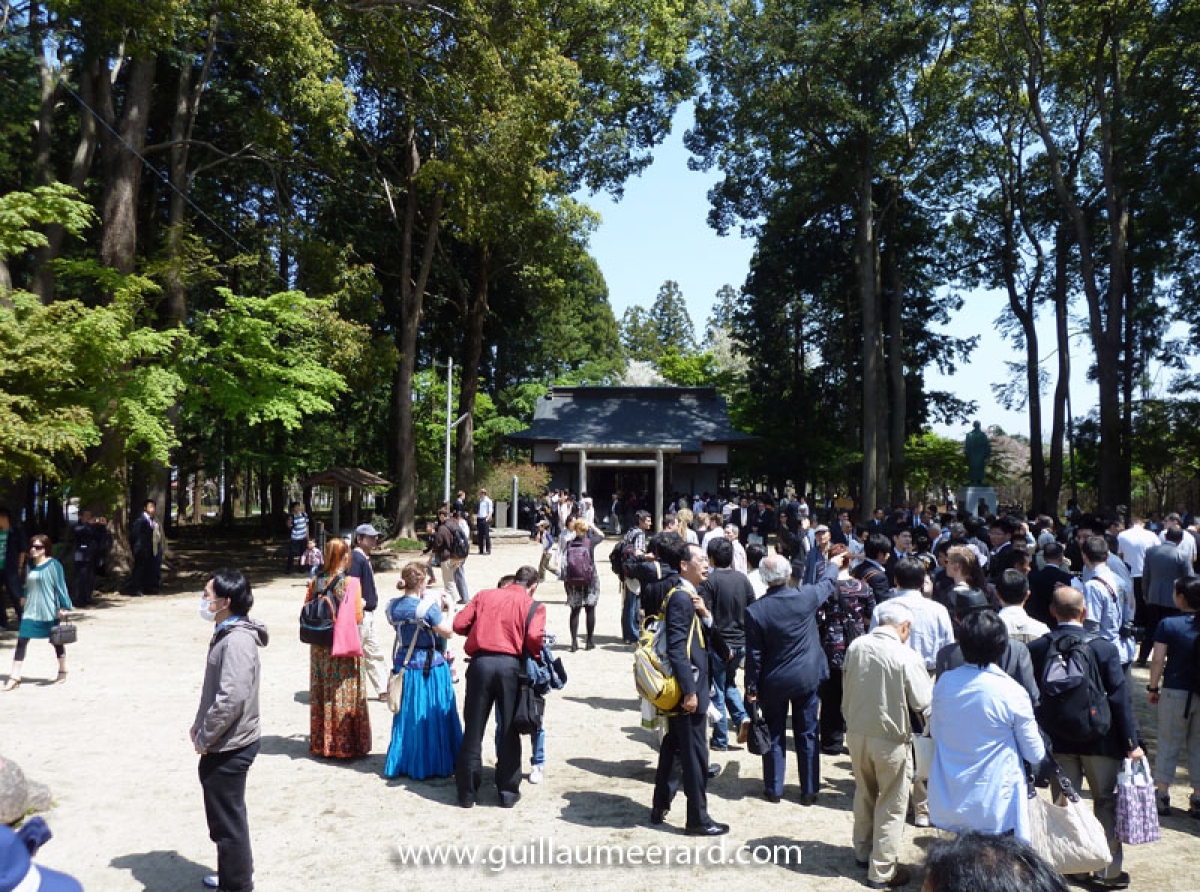
Once we arrive at Iwama station, a continuous line of practitioners coming form all over Japan and even abroad starts to make its way towards the shrine. Our arrival is not only observed by the local residents, but also by the deshi of the Iwama Shin-Shin Aïki Shuren-kaï dojo. Although they were formerly among the occupiers of the premises, they have been training in a building just across the road from the Aiki-jinja since Hitohira Saïto Sensei's decision to break his ties with the Aikikai.

Statue of O Sensei at the Aïki-jinja
On the other side of the road, the staff and instructors from the Aikikai are busy welcoming the visitors, receiving the donations, and even preparing the bento boxes kindly offered by the Aikikai to ach visitor. After registering and offering our donation, we head for the picnic area to reserve a spot in prevision of the upcoming lunch.

We return to the sanctuary at 11 o'clock sharp, just in time for the Shinto ceremony. It is being led under the direction of the priests of the Oomoto-kyo sect and will last for about an hour. Morihei Ueshiba had been a fervent follower of the sect and he infused many of the spiritual and humanistic teachings that he received from its founder, Onisaburo Deguchi, in his Aikido.
Video of the Shinto ceremony led by the priests of the Oomoto-kyo sect
Once the ceremony is over, it is up to the Doshu Moriteru Ueshiba and his son, Mitsuteru, to lead the festivities through an Aikido demonstration. The son is in charge of demonstrating the Suwari-waza and the father, the Tachi-waza. The demonstration is rather short but very dynamic. It is a real pleasure to see father and son complement each other through the technique.
Aikido demonstration by Waka Senseï Mitsuteru Ueshiba
Aikido demonstration by Doshu Moriteru Ueshiba
After the demonstration, the visitors disperse within the picnic area. People regroup by dojo, around a teacher, or by personal affinity. We decide to join the group of practitioners from the Aikikai Hombu Dojo and we all share a copious bento along with some sake, courtesy of the Aikikai. The weather is ideal for this outside lunch and the formality of the morning soon leaves the way to a more relaxed and festive mood.

Members of the Hombu Dojo sharing a bento
After lunch, we take the opportunity to have a look at the dojo built by O Sensei. A very peculiar feeling quickly gets us as we make our first steps in this unique place. This reminds us of our impressions when we first stepped on the tatami of the Tokyo Hombu Dojo. The Iwama Dojo is one of the historical site of refinement of Aikido, during the period of retirement of O Sensei to Iwama through the Second World War.

Outside of the Iwama Dojo
We are glad to see that the restoration of the Dojo seems to be complete and that it did not lose any of its former glory. It is also a great to think that this was made possible by the generous contributions of the international Aikidio community. The last wooden weapons used by O Sensei are still exposed in the dojo and one almost feel that he will appear at anytime in the dojo and demonstrate his fantastic techniques using these weapons.

Interior of the Dojo
After a final stroll around the site, it is time to board the train that will lead us back to Tokyo. The car is packed with Aikidoka and Sensei and it is in a very jolly mood that everyone goes back home after what has been a very lovely day in the countryside.
- How to get to Iwama from Tokyo?
At Ueno station, take the JR Joban line for Mito and get off at the Iwama station (1h50).