

In the koryu world, the term menkyo kaiden (免許皆伝) is often understood as “license of full transmission”, where it designates the highest level of exposure that an individual can receive in a certain martial tradition. In practice, menkyo kaiden is awarded by a teacher to one or a limited number of students, signifying that the teacher has taught everything he knows.
In the particular case of Daito-ryu, we explained previously that Hisa Takuma and Tonedate Masao are the only two people known to have received menkyo kaiden (or more strictly speaking, kaiden no koto) from Takeda Sokaku (Erard, 2012). However, it seems that at least one of Takeda’s earlier students, namely Horikawa Kodo, regularly referred to himself as menkyo kaiden throughout his life. A comparative study of the contents of the various titles awarded by Sokaku does indeed suggest that in terms of quantitative amounts of knowledge gathered, a number of people could reasonably claim a menkyo kaiden-equivalent level of exposure to the art.
In this article, we are going to attempt to shed some light on this apparent contradiction by looking at the documents received by some of Takeda’s most prominent students. We will try to summarize what is known about their respective training experience under Takeda and compare the content of their certificates. We hope that those findings will help adress some misunderstandings and bring new insights.
Ueshiba Morihei (1883-1969)
Ueshiba Morihei first met Takeda Sokaku at the Hisada inn in Engaru, Hokkaido in February 1915.
 The Hisada inn in Engaru, Hokkaido, where Ueshiba Morihei first met Takeda Sokaku.
The story has been told elsewhere but for the purpose of this article, the reader should know that Ueshiba participated in three 10-daysThe 10-days seminar format seems to have been quite common in Takeda Sokaku's teaching career. seminars with Takeda Sokaku, within a relatively short period of time.
 Page from Takeda Sokaku’s ledger dated from the 5th of March 1915. It states that a honorarium of 60 yen (i.e. 10 yen per person, which is about 11,000 yen today) was paid after a 10-days seminar. This is likely the first of the three seminars that Ueshiba Morihei (植芝盛平) participated in, and where he received instruction together with five other individuals, including Kotaro Yoshida.
After about a month of intensive training, Ueshiba Morihei returned to his Hokkaido settlement of Shirataki and built a dojo. He invited Takeda Sokaku to his home, where he formally enrolled as student, monjin (門人), in Daito-ryu Jujutsu (大東流柔術), together with fifteen or sixteen villagers (植芝, 2022).
According to the Daito-ryu records, Ueshiba Morihei participated in three of Takeda Sokaku’s seminars in 1916 and was awarded the Daito-ryu jujutsu hiden mokuroku (大東流柔術秘伝目録) scroll and the hiden okugi no koto (秘伝奥儀の事) scroll the same year.
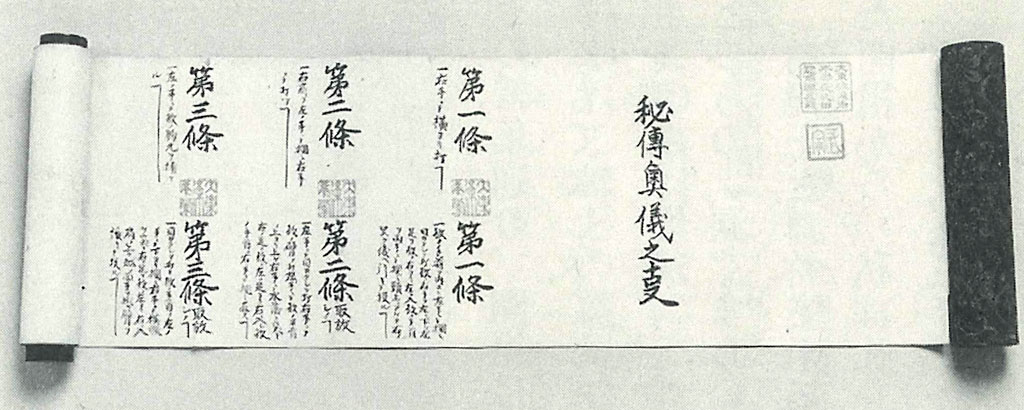 Hiden okugi no koto scroll received by Ueshiba Morihei from Takeda Sokaku in Shirataki in March 1916. Note that the mention "Daito-ryu jujutsu" is not present, even though Takeda Sokaku's "Daito-ryu Jujutsu Honbu-cho Takeda Sokaku Minamoto No Masayoshi" stamp is present.
Ueshiba Morihei then left Hokkaido hastily in December 1919 upon receiving news of his father’s illness. Shortly thereafter, in the spring of 1920, he moved to Ayabe with his family and joined the religious compound of Omoto, a new religious sect of Shinto that was very popular at that time. He had a close relationship with Deguchi Onisaburo, its charismatic leader, and it is Deguchi who urged Ueshiba to open a dojo and teach martial arts to the Omoto believers. Ueshiba opened his first dojo and called it “Ueshiba Juku” (植芝塾, litt.: Ueshiba Academy).
In April 1922, Takeda Sokaku appeared in Ayabe with his family and began teaching Daito-ryu to Ueshiba and his students at the Ueshiba Juku. This would be a very important period in both Daito-ryu and Aikido history since it is at that time that the term “Aiki” was added to the name of the art. Until 1922, it was the term “Daito-ryu Jujutsu” that was used in Takeda Sokaku’s official documents but from then on, it became “Daito-ryu Aikijujutsu” (大東流合気柔術). Interestingly, the term is said to have been suggested by Deguchi Onisaburo, and even though it is quite clear that him and Takeda did not like each other, Sokaku used it from then on, albeit not exclusively (Dobroka, 2024).
 Ueshiba Morihei sitting at the Ueshiba Juku in Ayabe in front of a board bearing the name Daito-ryu Aiki Jujutsu (大東流合気柔術).
After five months of teaching, Takeda Sokaku listed Ueshiba Morihei in his eimeiroku (英名録, name registery) as a kyoju dairi (教授代理, representative instructor) in September 1922. The evidence at our disposal based on the study of Takeda Sokaku's eimeiroku and shareiroku (謝礼禄, ledger of payments received) indicates that Ueshiba's is the first ever kyoju dairi that he awarded in Daito-ryu Aiki-jujutsu, which suggests that Morihei possessed a level of mastery of Sokaku's Aiki (previous ones do exist, but they were awarded, as we saw, in Daito-ryu jujutsu).
 Excerpt from Takeda Sokaku's eimeiroku showing that he awarded the Kyoju Dairi to Ueshiba Morihei on September 15th, 1922.
The entry translates as follows:
Teaching Representative Morihei Ueshiba15 September 1922
- When accepting students for instruction in Daito-ryu Aiki-jujutsu, be careful to choose persons of good conduct.
- When instructing students, require them to write their address, name, age, location of their dojo, and the terms of their instruction in a registration book together with their seal by way of authentification.
- 3. When instructing students, an initial payment of three yen shall be made to Takeda Dai Sensei as an enrollment fee.
There exists an entry in Takeda Sokaku’s shareiroku from the same day stating that a payment of 100 yen (about 80 000 yen today) and a sword were received from Ueshiba Morihei as an honorarium.
 Page from Takeda Sokaku's shareiroku showing that Ueshiba Morihei remitted the sum of 100 yen and a sword to Takeda as a payment on the 15th of September 1922.
The page shown above served as proof of a sort of financial arrangement that connected Takeda Sokaku and his teaching representatives. We can see Ueshiba’s stamp twice on the eimeroku page, once under his name and once over the 参圓 character of three yen (about 2,400 yen today) hence acknowledging the associated financial requirements. This precise agreement would create tensions between the two men later on and the subject is discussed in length here (Amdur, 2019).
Interestingly, one month earlier, in August, Takeda Sokaku awarded Ueshiba a certificate entitled “Daito-ryu Aikijujutsu hiden okugi no koto” (大東流合氣柔術秘傳奧儀之事). This very certificate can be seen prominently displayed in many pictures taken at the Kobukan Dojo around 1931.
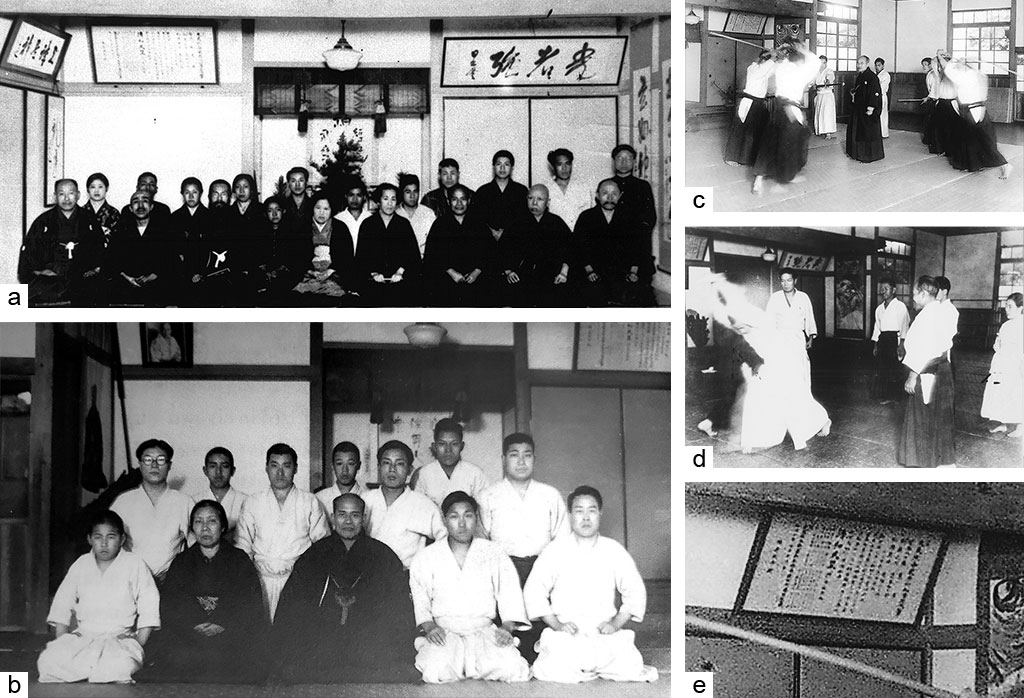 Montage showing pictures taken at the Kobukan at various times, prominently displaying Ueshiba Morihei's hiden okugi no koto. (a) Ueshiba Morihei with Deguchi Naohi and Deguchi Hidemaro of Omoto religion (1931). The Hiden Okugi no Koto certificate is displayed on the left side of the Kamiza. (b) With a group of students Ueshiba Hatsu, Ueshiba Morihei, Funabashi Kaoru, Shirata Rinjiro back row on the right. (e) Close-up of the certificate.
These pictures are too blurry to read but fortunately, the content of this certificate was partially transcribed by Ueshiba Kisshomaru his "Aikijujutsu" chapter in the 6th volume of the Nihon Budo Taikei (今村 et. al., 1982), which allows us to have a better idea of what Ueshiba learned from Takeda during the Ayabe period.
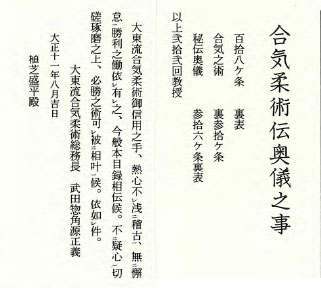 Excerpt from Nihon Budo Taikei Vol.6, "Aikijutsu" chapter written by Ueshiba Kisshomaru.
According to the publication techniques are listed as follows:
- 118 kajo ura omote (百拾八ヶ条 裏表)
- Aiki no jutsu ura 30 kajo (合氣之術 裏参拾ヶ条)
- Hiden okugi 36 kajo ura omote (秘伝奧儀 参拾六ヶ条裏表)
- The above was taught in 22 occasions (以上弐拾二回教授)
The 118 techniques and hiden okugi 36 techniques correspond to the Daito-ryu jujutsu hiden mokuroku and hiden okugi no koto scrolls, respectively, that Ueshiba received previously in Hokkaido. We can deduce that Takeda probably taught Ueshiba the Aiki no jutsu techniques during his stay in Ayabe. References to the term Aiki are present in sentences such as in “Apply Aiki” (合気をかける) as early as 1913 in the notes of Sagawa Nenokichi, an early student of Takeda and father of Sagawa Yukiyoshi. However, Aiki no jutsu as a set of 30 techniques appears here in the Daito-ryu curriculum for the first time. As far as we know, Ueshiba Morihei was probably the first who received this certificate and it must have been the highest level license in Daito-ryu at that time.
As we will see, in later versions of this certificate, the 84 techniques of goshin'yo no te are added after the hiden okugi 36 techniques. It is possible that in 1922 goshin'yo no te did not yet exist as a set of techniques and that it was developed or added to the curriculum later. In a later entry of the eimeiroku, we can find evidence that Takeda Sokaku did teach the 84 goshin'yo no te techniques to Ueshiba Morihei.
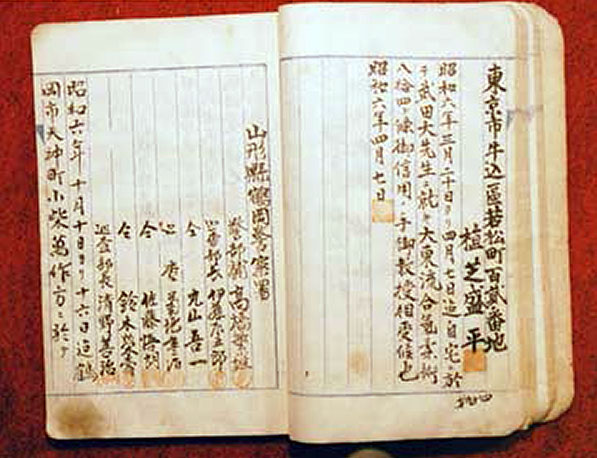 Page from Takeda Sokaku's eimeiroku showing that Ueshiba Morihei was taught goshin'yo no te at Ueshiba’s house in Ushigome Wakamatsu-cho, Tokyo from March 20 to April 7 in 1931.
There is also a corresponding payment of 300 yen (about 190,000 yen today) from Ueshiba Morihei in Takeda Sokaku’s shareiroku dated March 28 of the same year.
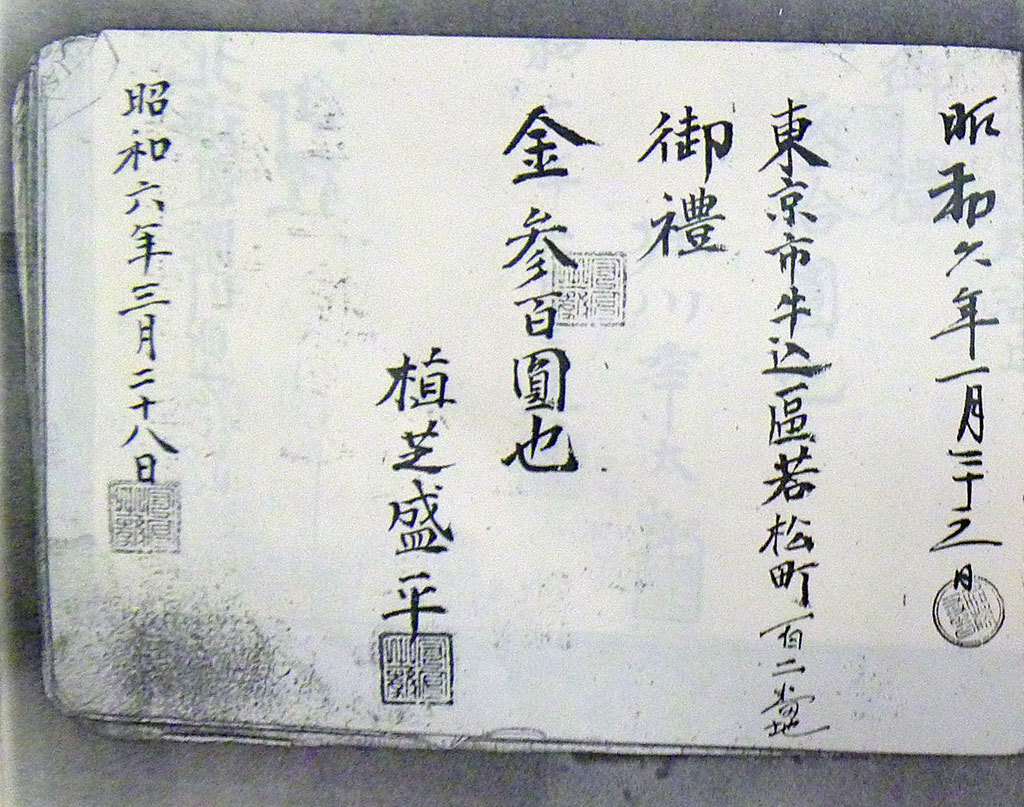 Excerpt dated from March 28, 1931 showing that Ueshiba Morihei paid the sum of 300 yen to Takeda Sokaku.
We can speculate that Takeda compiled the goshinyo no te set of 84 techniques after the Ayabe period and that went back to Ueshiba, his earlier student, to teach him these new techniques and variations. Interestingly, Ueshiba’s Kobukan Dojo opened very soon after in April 1931. A commemorative picture of the dojo opening was taken but Takeda Sokaku is not in present. It is possible, though a little strange, that the event might have taken place after Takeda left Tokyo.
 Grand opening of the Kobukan Dojo in April 1931. Front row, third from left, Ueshiba Hatsu, Ueshiba Kisshomaru; seated in the center, Ueshiba Morihei, Admiral Asano Seikyo, Admiral Takeshita Isamu, General Miura Makoto. The Ueshiba Juku calligraphy of Onisaburo can be seen on the wall. However, Ueshiba’s hiden okugi no koto certificate is not displayed on the wall yet.
In the 1930s, Ueshiba gradually distanced himself from Takeda and called his art various names such as Ueshiba-ryu Jujutsu, Aioi-ryu Jujutsu, Aiki Budo, and eventually Aikido (Erard, 2020). As the Founder of Aikido, it is not surprising that he did not go under the title of menkyo kaiden, although, for all intents and purposes, he held the highest title in Daito-ryu in the 1920s.
Horikawa Kodo (1894-1980)
Horikawa Kotaro (who would later take on the name of Kodo) started his Daito-ryu training at the age of eleven under his father, Horikawa Taiso, who was himself a kyoju dairi student of Takeda. Takeda was aware that Taiso was teaching his son and he told him, “When you have run out of things to teach him, send him to me and I will work with him.” Horikawa Kodo officially enrolled as Takeda Sokaku’s student in 1914, at the age of twenty-one.
 Horikawa Taiso, Takeda Sokaku, and Horikawa Kotaro (Kodo) ca. 1930.
Later on, Takeda Sokaku taught Kodo intensively over the course of three years. Kodo received most of his teaching from Takeda via private lessons.
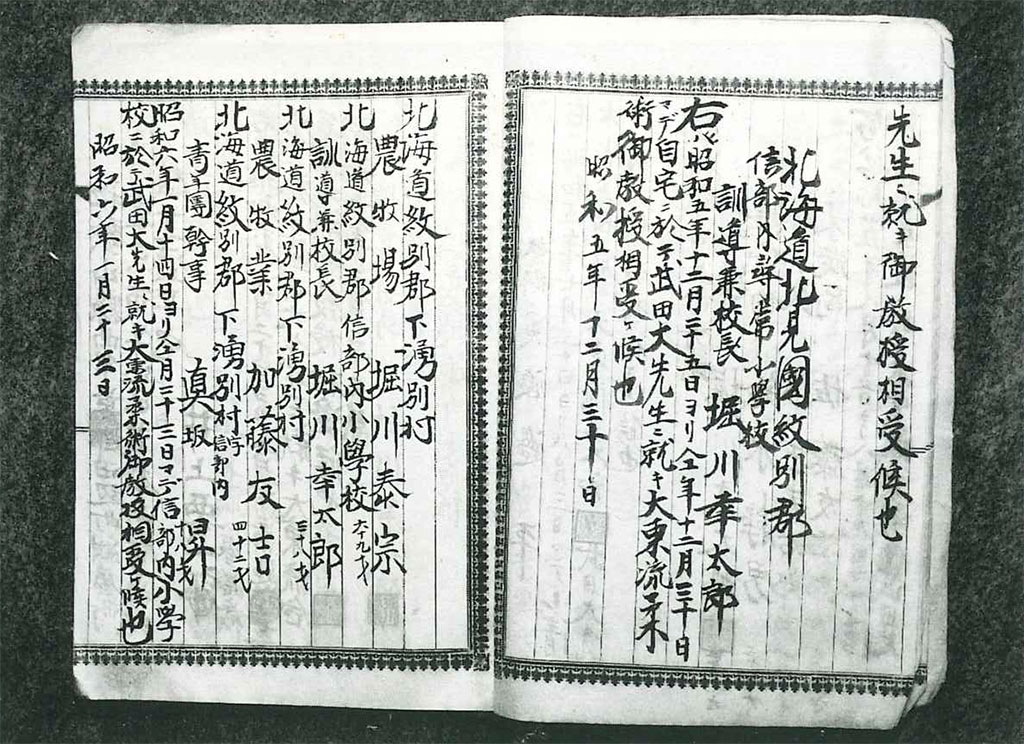 This page of the eimeiroku shows two occasions of Horikawa receiving instruction. One is a private lesson, the other one is a ten-day seminar taught by Takeda in Shimoyubetsu, where Kodo, his father, and two other individuals participated.
Inoue Yusuke, former headmaster of Kodokai talks about Kodo’s training as follows:
[...] what he learned in the seven years under his father was Daito-ryu Jujutsu, and during the three years with Sokaku Takeda Sensei he learned Aikijujutsu. Stanley Pranin - Conversations with Daito Ryu Aikijujutsu Masters (p. 102)
It is said that Kodo was of small built, and that he did not possess much physical power, so Sokaku Sensei would have told him: “You do Aikijujutsu.” Indeed, a characteristic of the Horikawa line’s technical curriculum is the the large number of Aiki techniques.
Horikawa Kodo demonstrating Aiki techniques in his later years.
Kodo received the Daito-ryu jujutsu hiden mokuroku scroll in January of 1931, the hiden okugi no koto scroll in June, and was listed as kyoju dairi in October of the same year. According to the Kodokai, Takeda gave Kodo the Daito-ryu aikijujutsu okugi scroll and a so-called “menkyo kaiden” certificate to copy, most likely in October 1931. He is said to have told Kodo, “Prepare a copy and next time I come, I will stamp it with my seal.” After that, Takeda Sokaku left for Kansai and the two men never met again, so the certificate remained unstamped.
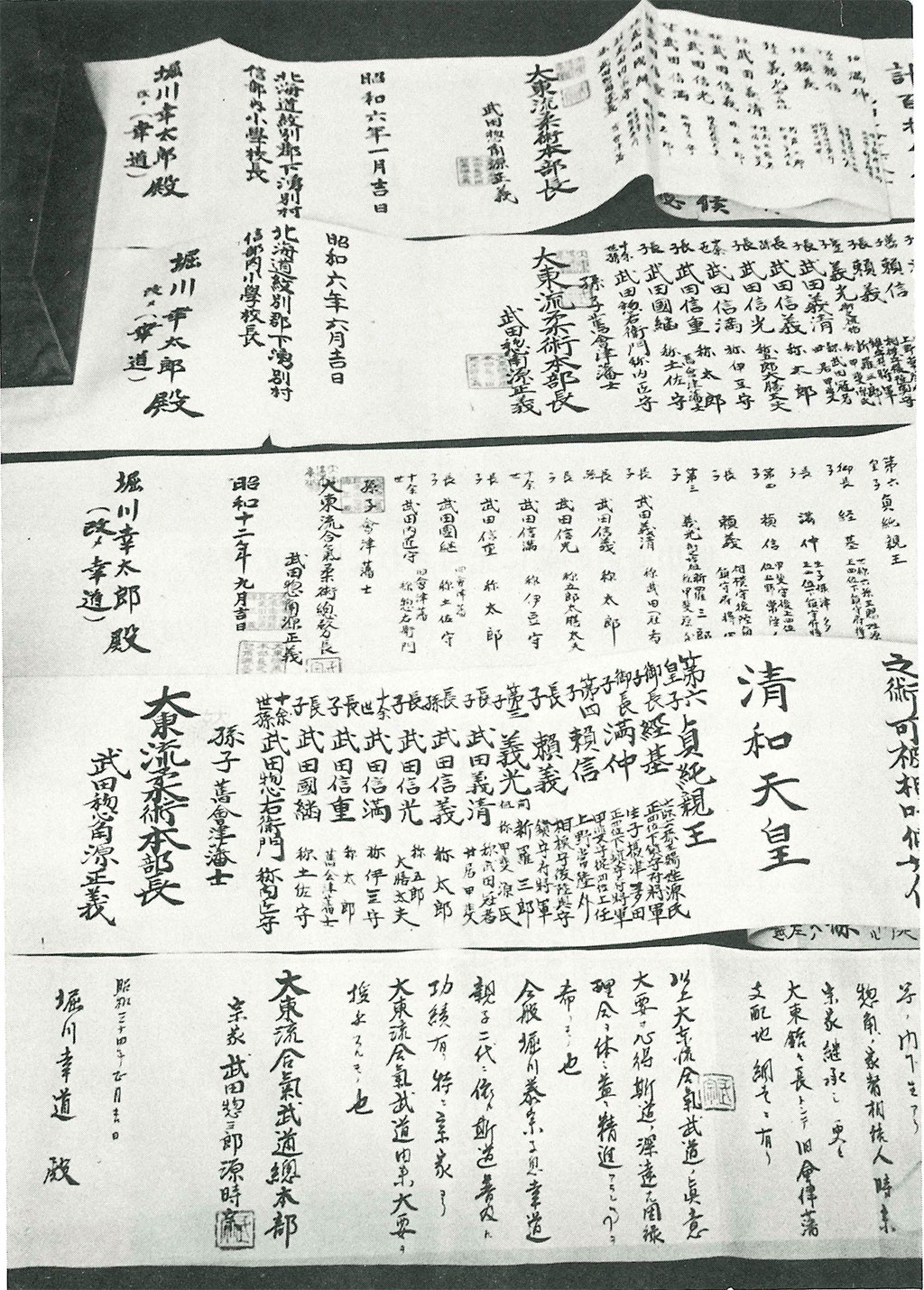 Horikawa Kodo’s scrolls of Daito-ryu transmission. From the top: Daito-ryu jujutsu hiden mokuroku, hiden okugi no koto, Daito-ryu aikijujutsu hiokugi no koto, Daito-ryu aikijujutsu okugi (unstamped), and Daito-ryu aikibudo taiyo (Record of Origins received from Tokimune Takeda).
Horikawa’s unstamped menkyo kaiden and scroll were shown in a TV program called “Hokkaido no Mado” (A Window to Hokkaido) broadcast on the NHK channel in May, 1973. Unfortunately, the video is not available for public view, but a few pictures taken during this event survived.
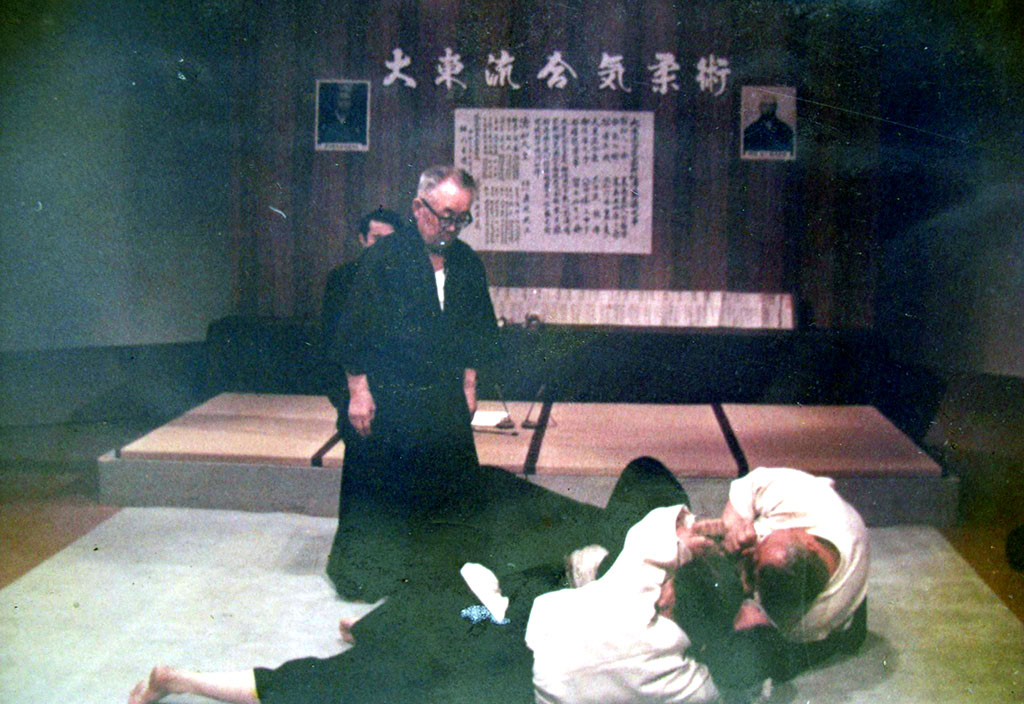 Horikawa Kodo demonstrating Aiki on three people during the "Hokkaido No Mado" TV program broadcast on the NHK in May, 1973. The unstamped certificate and scroll are displayed in the back.
Only based on this picture, it is difficult to tell what is written on the certificate. However, in a recent interview we did with Nomoto Tadashi Sensei, he stated that in the Horikawa line, the certificate of Daito-ryu aikijujutsu hiden okugi no koto was actually passed down as a menkyo kaiden. I therefore compared Nomoto sensei’s certificate to the one that was showed in the TV program.
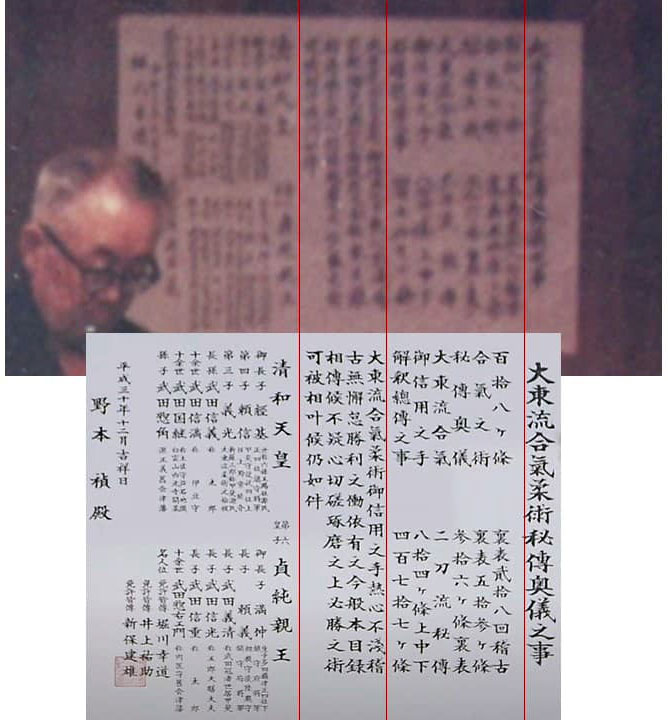 The Daito-ryu aikijujutsu hiden okugi no koto certificates of Horikawa Kodo Sensei (top) and Nomoto Tadashi Sensei (bottom) look very similar.
Based on the shape and number of characters the two certificates seem to be identical. As a result, we can assume the title and content of Kodo’s “menkyo kaiden” certificate would read as follows:
- Daito-ryu aikijujutsu hiden okugi no koto (大東流合氣柔術秘傳奧儀之事)
- 118 kajo ura omote 28 kai keiko (百拾八ヶ條 裏表貮拾八回稽古)
- Aiki no jutsu ura omote 53 kajo (合氣之術 裏表五拾参ヶ條)
- Hiden okugi 36 kajo ura omote (秘伝奥儀 参拾六ヶ條裏表)
- Daito-ryu aiki nito-ryu hiden (大東流合氣 二刀流秘傳)
- Goshinyo no te 84 kajo jo-chu-ge (御信用之手 八拾四ヶ條上中下)
- Kaishaku soden no koto 477 kajo (解釈總傳之事 四百七拾七ヶ條)
The list is followed by the same short text and lineage of the Takeda family as written on Ueshiba Morihei’s certificate. Although the title is the same as on Ueshiba’s certificate, it contains a larger number of techniques. The 118 techniques and the 36 hiden okugi techniques are the same, however here is written the fact that this teaching took place over 28 times of training. Kodo’s certificate mentions 53 aiki no jutsu techniques instead of Ueshiba's 30. In addition, the aiki nito-ryu, goshinyo no te, and kaishaku soden techniques appear here for the first time in a Daito-ryu certificate.
Kaishaku soden can be translated as “explanation of full transmission”. In 1931, this certificate must have been the highest level of transmission in Daito-ryu and Kodo was the first one who received it from Takeda. Hence, it’s not surprising that Kodo would refer to it as menkyo kaiden during his life, which then explains the fact that this certificate is being passed down as menkyo kaiden in the Horikawa line.
Tokimune knew about the fact that Sokaku promised Kodo a menkyo kaiden and that he passed away before he could officialize it. Kodo approached Tokimune to get this done and he passed on his unsigned certificate to Tokimune, but instead of stamping Kodo’s certificate, Tokimune gave him a slightly different certificate entitled Daito-ryu aikibudo hiden okugi no koto (大東流合氣武道秘傳奧儀之事).
 Daito-ryu aiki-budo hiden okugi no koto certificate handed to Horikawa Kodo by Takeda Tokimune.
Daito-ryu aikibudo was the term that Tokimune used to call his art during his life. It’s a combination of jujutsu, aikijujutsu and Takeda-den Onoha itto-ryu kenjutsu techniques. Its content reads as follows:
- Hiden mokuroku 118 kajo ura omote (秘傳目録 百拾八ヶ條 裏表)
- Aiki no jutsu ura omote 53 kajo (合氣之術 裏表五拾参ヶ條)
- Hiden okugi 36 kajo ura omote (秘傳奥儀 参拾六ヶ條裏表)
- Daito-ryu aiki hitachi 36 kajo hiden (大東流合氣秘太刀 参拾六ヶ條秘傳)
- Aiki hiden okugi 84 kajo (合氣秘傳奥儀 八拾四ヶ條)
- Kaishaku soden no koto 477 kajo (解釈總傳之事 四百七拾七ヶ條)
The first three items in the list are referring to the same sets of techniques as seen before. However, instead of the secret two sword techniques, Tokimune’s certificate mentions secret techniques using one sword. Most likely, it refers to the Onoha itto-ryu techniques taught by Takeda Sokaku. Another difference is that instead of 84 goshinyo no te techniques, 84 aiki hiden okugi techniques are listed, however, the difference between these techniques is unclear. The list ends with 477 kaishaku soden no koto techniques in both cases. On the other hand, it is worth noting that according to Mrs Horikawa, Tokimune did not own the fourth Daito-ryu aikijujutsu okugi scroll that Kodo received from Takeda, and it is Kodo who copied it and gave it to him.
In his later years, Kodo consistently used the menkyo kaiden as a title in his publications and on official documents.
Hisa Takuma (1895 - 1980)
Hisa Takuma first learned from Ueshiba Morihei when he was invited to Osaka to teach self-defense to the members of the Asahi Newspaper’s security team in 1934 (Erard, 2012). Impressed by the techniques of Ueshiba, Hisa and the members of the dojo decided to take pictures after the classes using the Newspaper’s photographic equipment. Luckily, these pictures survived and were compiled by Hisa Takuma into several volumes called Daito-ryu Aiki-budo Densho Zen Juikkan (大東流合気武道伝書全十一巻), which is more widely known as Soden (総伝) (Erard, 2019).
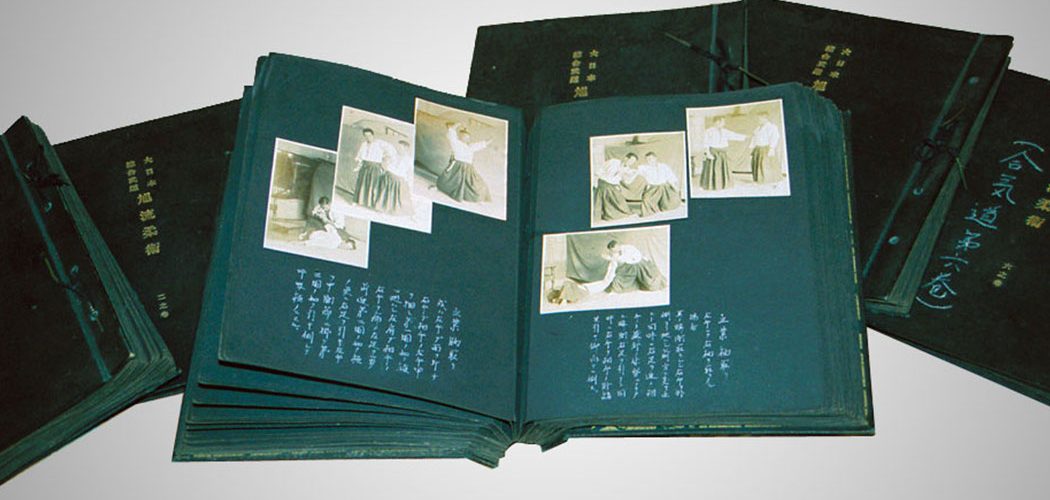 Some of the volumes of the Soden, a compilation of all the techniques taught by Ueshiba Morihei and Takeda Sokaku at the Asahi Newpaper.
Ueshiba did not call the art he taught at the newspaper Daito-ryu, but he argued that since they were practicing at the Asahi Journal it should be called Asahi-ryu Jujutsu. Takeda appeared in Osaka in the June of 1936 and took over the teaching of the group (Erard., 2019). He seemed to have been satisfied with the technical level of the members and awarded them several certificates within a few months of his arrival.
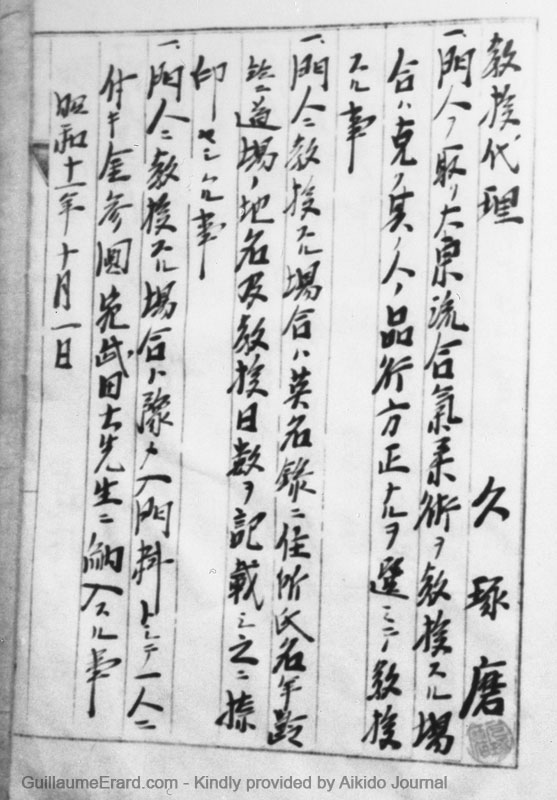 Excerpt from Takeda Sokaku’s eimeiroku showing that Hisa Takuma received the title of kyoju dairi on October 1st, 1936.
Hisa was registered as kyoju dairi on October 1st, 1936, with the same above-mentioned financial conditions. At the same time, Takeda awarded the group, including Nakatsu Heizaburo, the Daito-ryu aikijujutsu hiden okugi no koto (Erard, 2016).
 Hiden okugi no koto certificate awarded to Hisa Takuma in October 1936 by Takeda Sokaku.
The content of Hisa’s certificate reads as follows:
- 118 kajo ura omote (百拾八ヶ条 裏表)
- Aiki no jutsu ura 30 kajo (合氣之術 裏参拾ヶ条)
- Hiden okugi 36 kajo ura omote (秘傳奧儀 参拾六ヶ条裏表)
- The above was taught in 25 occasions (以上弐拾五囬教授)
- Goshinyo no te 84 kajo with the mention that it was taught during one occasion (御信用之手八拾四ヶ條 壹囬教授)
The first three items are also listed in Ueshiba’s certificate, however, instead of 22 occasions, in Hisa’s case, 25 sessions of teaching are mentioned. This is followed by 84 goshinyo no te techniques. These are the techniques that Ueshiba Morihei later learned from Takeda Sokaku in Tokyo. Altogether, Hisa’s certificate covers all the techniques that Ueshiba learned from Takeda between 1915 and 1931. Just like in the case of Ueshiba, the dates on the certificates strongly suggest that in his later years, Takeda sometimes listed people as kyoju dairi and awarded them the hiden okugi no koto certificate simultaneously.
This certificate basically validated Ueshiba's teaching to the group up to that point. The specifics of Takeda's teaching to the group can be found later in the kaishaku soden no koto level, which was recorded to have been taught to Hisa and others in the group.
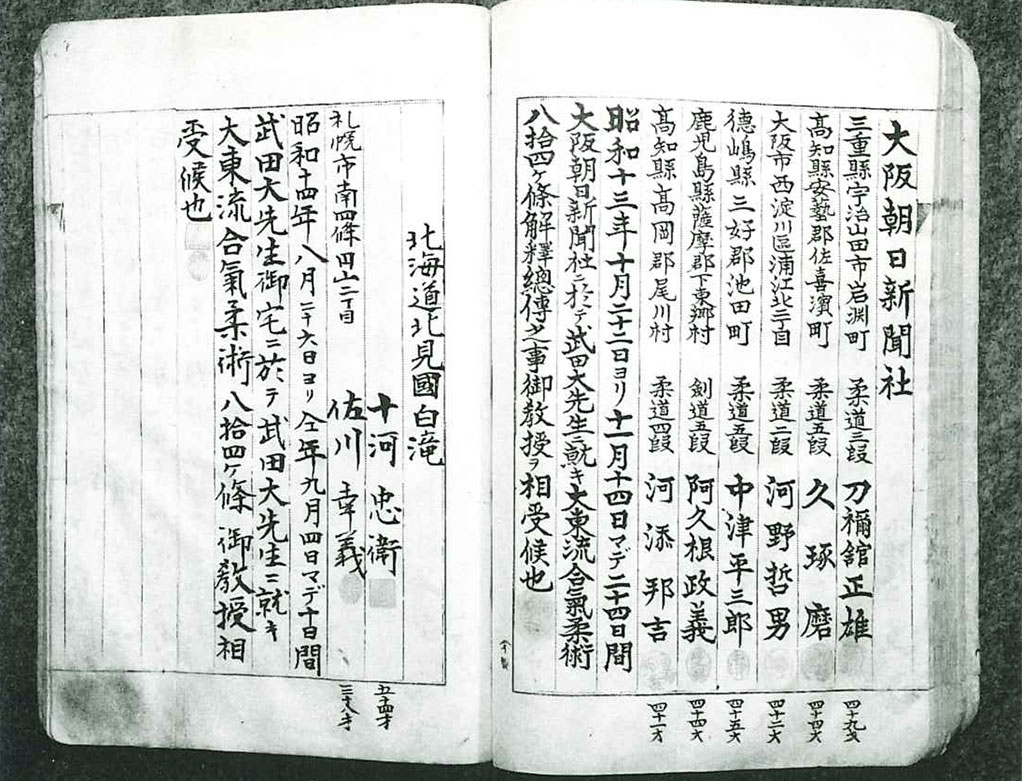 Entry from Takeda Sokau's eimeiroku showing that he taught the 84 kaishaku soden techniques to the Asahi members including Tonedate Masao, Hisa Takuma, Kono Tetsuo, Nakatsu Heizaburo, Akune Masayoshi and Kawazoe Kuniyoshi for 24 days from October 22th to November 14th, 1938.
Takeda went even further and taught Hisa and Tonedate the 88 kaiden no koto techniques.
 Pages from Takeda Sokaku’s eimeiroku showing that he taught Tonedate Masao (left) and Hisa Takuma (right) the 88 kaiden no koto techniques from February 24th to March 26th, 1939.
According to these pages, the training period was 31 days and the instructors were both Takeda Sokaku and Takeda Tokimune.
We have thus far studied the eimeiroku record and interpreted literally all of its entries. It is important to note however that according to both Takeda Tokimune and the Takumakai, Hisa was actually the only one to have been taught the kaiden no koto techniques, and that Tonedate received the certificate mostly in an honorary manner, since as the editor of the newspaper, he was too busy to train regularly with the group (Erard, 2012).
 Hisa’s kaiden no koto entry in Takeda’s eimeiroku dated March 1939. Takeda and Hisa with the Kaiden no Koto certificate at the Asahi Newspaper in 1939.
Hisa’s diploma is not available to us but in a memorial picture taken of Takeda Sokaku and Hisa Takuma, the latter is holding his certifcate and fortunately, the resolution of this picture is good enough to allow further examination.
- 118 kajo ura-omote (百拾八ヶ條裏表)
- Aiki no jutsu ura-omote 53 kajo (合気之術裏表五拾参ヶ條)
- Hiden okugi 36 kajo ura-omote (秘伝奥儀参拾六ヶ條裏表)
- Daito-ryu aiki nito-ryu hiden (大東流合気二刀流秘伝)
- Goshinyo no te 84 kajo jo-chu-ge (御信用之手八拾四ヶ條上中下)
- Kaishaku Soden no koto 477 (解釈總傳之事四百七拾七)
- Kaiden no koto 88 kajo (皆伝之事八拾八ヶ條)
The first six items cover the same content as on Kodo’s certificate. They are followed by the 88 kaiden no koto techniques. It is this certificate that is sually referred to as menkyo kaiden or full transmission in Daito-ryu. However the word “menkyo kaiden” (免許皆伝) is not actually written in the certificate, and it is not in Takeda’s eimeiroku either. Menkyo kaiden is in fact a general koryu term and it was probably used to refer to this certificate in the later generations. Unfortunately, we don’t know much about the nature and amount of Nito-ryu instructions Hisa and others might have received at the Asahi Dojo. Hisa’s and the Asahi member’s training with Sokaku continued untill 1939.
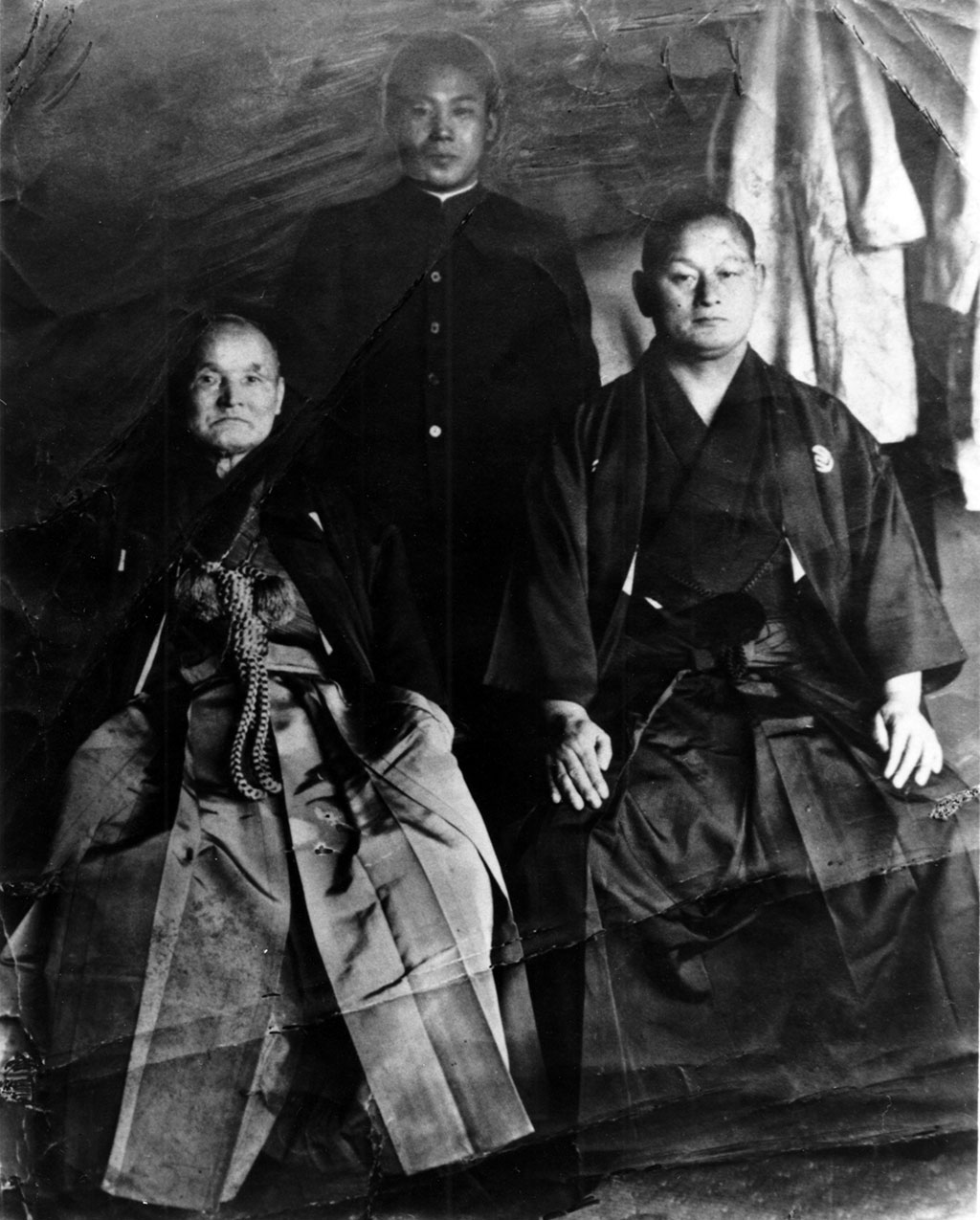 Takeda Sokaku, Takeda Tokimune, and Hisa Takuma at the Asahi Newspaper, c. 1939.
Sagawa Yukiyoshi (1902-1998)
Just like Kodo, Sagawa Yukiyoshi started his Daito-ryu training under his father, Sagawa Nenokichi (佐川 子之吉), and hr officially became Takeda Sokaku's student in 1914. The Sagawas' names appear frequently in Takeda's eimeiroku and shareiroku in these years.
Sagawa Yukiyoshi became kyoju dairi of Takeda Sokaku on August 24, 1932, in Hokkaido. It is also recorded that he accompanied Takeda as an assistant, instructing in various parts of Japan during the 1930s. Sagawa received the Daito-ryu Aikijujutsu hidenokugi no koto certificate in the May 1938.
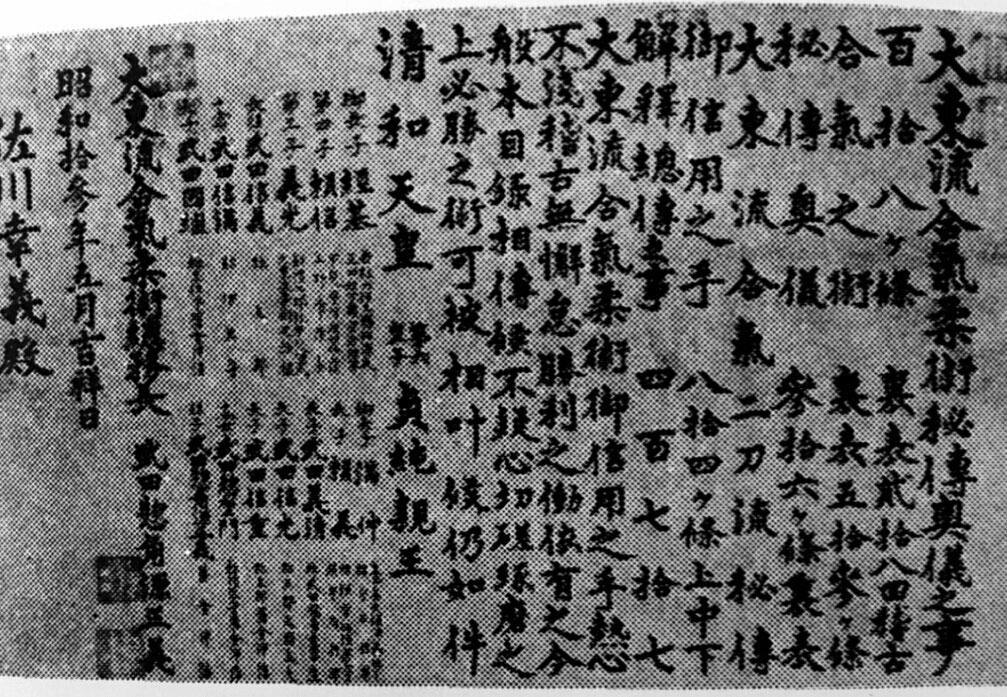 Hiden okugi no koto certificate received by Sagawa Yukiyoshi from Takeda Sokaku in May 1938.
Its content is identical to the one that was given to Horikawa earlier in 1932. Interestingly one year later, Takeda gave another Daito-ryu Aikijujutsu hidenokugi no koto certificate to Sagawa, but which contained additional content.
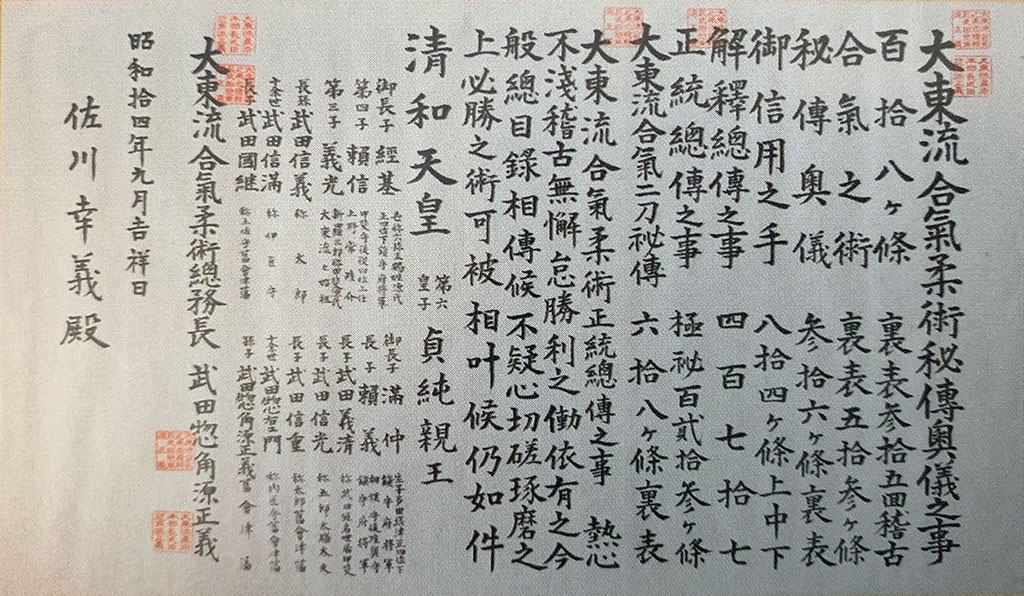 Second Daito-ryu aiki-jujutsu hiden okugi no koto certificate received by Sagawa Yukiyoshi from Takeda Sokaku in September 1939.
The list of techniques reads as follows:
- 118 kajo ura omote 28 kai keiko (百拾八ヶ條 裏表貮拾八回稽古)
- Aiki no jutsu ura omote 53 kajo (合氣之術 裏表五拾参ヶ條)
- Hiden okugi 36 kajo ura omote (秘伝奥儀 参拾六ヶ條裏表)
- Goshinyo no te 84 kajo jo-chu-ge (御信用之手 八拾四ヶ條上中下)
- Kaishaku Soden no koto 477 kajo (解釈總傳之事 四百七拾七ヶ條)
- Seito soden no Koto gokuhi 123 kajo (正統總傳之事 極秘百貮拾参ヶ條)
- Daito-ryu aiki nito hiden 68 kajo ura omote (大東流合氣二刀秘傳 六拾八ヶ條裏表)
The certificate is dated from September 1939, which is six months after Hisa received his kaiden no koto certificate. Up to the kaishaku soden no koto techniques it covers mostly the same contents as listed in Kodo’s and Hisa’s certificates. However, in Sagawa's scroll instead of the 88 kaiden no koto (皆伝之事, full transmission) techniques, 123 seito soden no koto (legitimate full transmission) techniques are listed.
Hisa's kaiden no koto is often referred to as menkyo kaiden (license of full transmission) of the tradition but seito soden is not mentioned in his certificate. It might be a set of techniques that Takeda only taught to Sagawa. Unfortunately, we don't know much about these techniques and how they are different from kaiden no koto techniques.
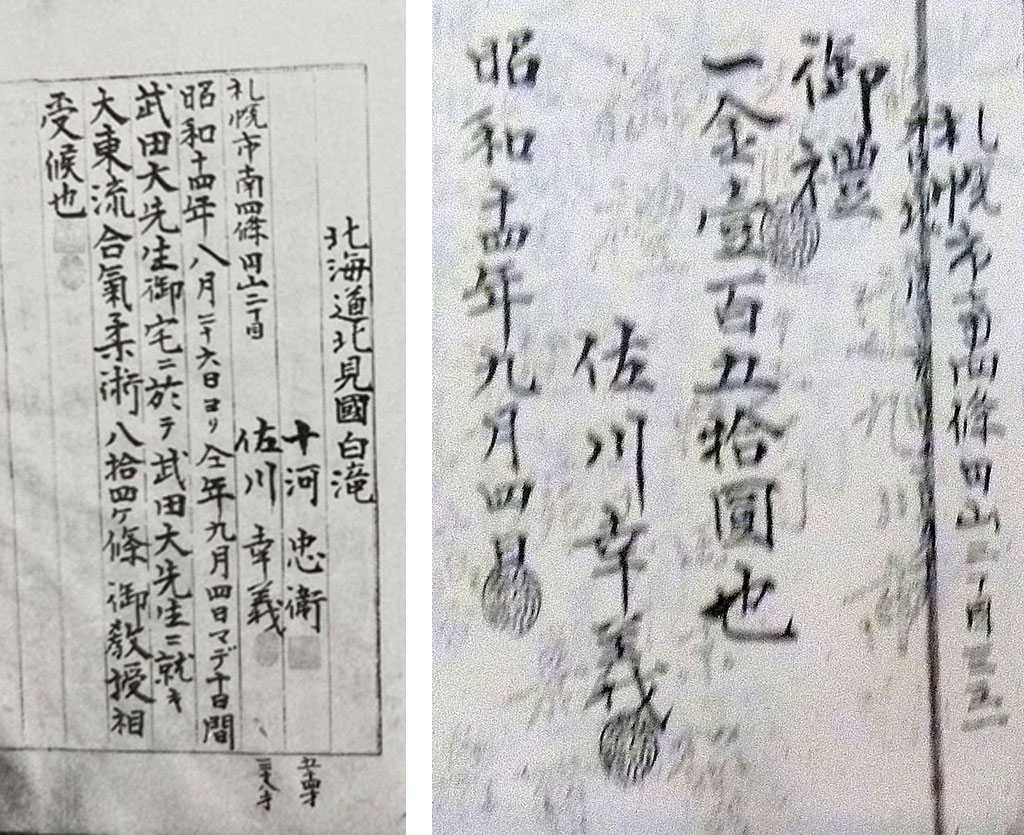 Takeda Sokaku’s eimeiroku showing that Sagawa Yukiyoshi learned 88 Daito-ryu Aikijujutsu techniques from August 26 to September 4, 1939 (left) and the corresponding shareiroku page with a record of 150 yen from Sagawa on September 4, 1939 (right).
A study of the eimeiroku and shareiroku revealed that Sagawa received instruction from Takeda at that time. The page records a 10 days training session from August 26 to September 4, at Takeda Sokaku’s house in Shirataki, where Sagawa Yukiyoshi together with Sogawa Tadae (kyoju dairi in 1940) learned 84 techniques of Daito-ryu Aikijujutsu. Unfortunately, the exact content of the transmission is not mentioned. A standard payment for a 10 days seminar was about 10 yen, however, at this time the shareiroku shows a substantial payment of 150 yen (about 75,000 yen today) on September 4, 1939.
For context, the following page of Takeda Sokaku's shareiroku shows that five months earlier, Hisa and Tonodate paid altogether 300 yen after their kaiden no koto transmission took place. Considering the amount of Sagawa's payment, it is quite possibly his honorarium for the seito soden transmission and the certificate.
 Page from Takeda Sokaku's shareiroku showing that Hisa Takuma and Tonodate Masao paid altogether 300 yen shortly after after their kaiden no koto transmission took place.
In addition, 68 Daito-ryu aiki nito hiden techniques are mentioned on this certificate.
 Sagawa Yukiyoshi demonstrating Aiki with two swords.
In these pictures, we can see Sagawa demonstrating two different Aiki nito-ryu techniques. The one on the left is from the book Hiden Nihon Jujutsu (秘伝日本柔術, Secret Japanese Jujutsu) published in 1978. The younger Sagawa uses two long swords and controls his opponent while steeping behind him. The one on the right is from Sagawa’s later years. Here he is holding a short and a long sword throwing his opponent backward with Aiki.
In the third Daito-ryu aikijujutsu hiokugi no koto (大東流合氣柔術秘奧儀之事) scroll that Takeda gave to Horikawa in 1931, we can find explicit instructions for two Daito-ryu nito-ryu hiden techniques.
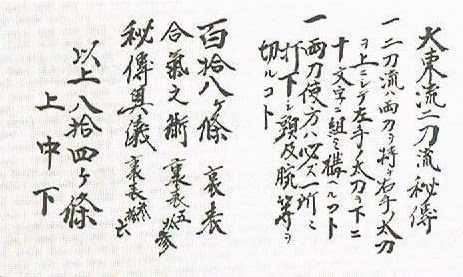 Excerpt from the Daito-ryu aikijujutsu hiokugi no koto givne by Takeda Sokaku to Horikawa Kodo.
The text translates as follows:
一 二刀流ハ両刀ヲ持チ右手ノ太刀ヲ上二シテ左手ノ太刀ヲ下二十文字二組ミ構ヘルコト
One: In Nito-ryu, hold two swords, a long sword in the right hand is the higher, a long sword in the left hand is the lower, cross them (in a shape of the character ten 十)二 両刀使方ハ必ズ一所二打下シ頭及腕等ヲ切ルコト
Two: When you use two swords use them together and cut the head or the arm.
Recently, Nomoto sensei demonstrated this technique for us, as it is passed down in the Horikawa line:
You can see the crossed block with two long swords. Then he applies Aiki to control the opponent and cut the body using the two swords together.
Considering that Sagawa’s scroll from 1939 lists 60 nito-ryu variations, it is possible that Takeda Sokaku developed these techniques gradually during the 1930s. Horikawa’s scroll is very specific about the two long swords so Sagawa’s technique showing him use a short and a long sword could be a later development by Takeda, or even an interpretation by Sagawa himself.
In terms of sheer number of techniques learnt from Takeda, Sagawa’s certificate contains the highest number, yet he has never been referred to as menkyo kaiden. In his later years, Sagawa used the tile sohan (宗範, head instructor) and called his art Daito-ryu aikibujutsu.
Yamamoto Kakuyoshi (1914-1982)
Yamamoto Tomekichi (later Kakuyoshi) is known as the last student of Takeda. Yamamoto was a cook and he first met Takeda Sokaku, when Takeda came to the restaurant where Yamamoto was working in Hokkaido. Yamamoto was impressed by Takeda’s techniques and became his student around 1940. One year later, Yamamoto became Takeda’s uchi-deshi and took care of his teacher from then on. In his final years, Takeda was paralyzed on one side of his body and had difficulty moving. Yamamoto received his hiden okugi no koto certificate in 1941. He received instruction in Daito-ryu and kenjutsu from Takeda and became kyoju dairi in 1942.
It seems that when Takeda approved someone as his teaching representative, he asked the individual to start his own eimeiroku and Takeda officiated the first of its page with his stamps. Unfortunately, little information is available regarding the eimeiroku of Takeda Sokaku's other kyoju dairi students.
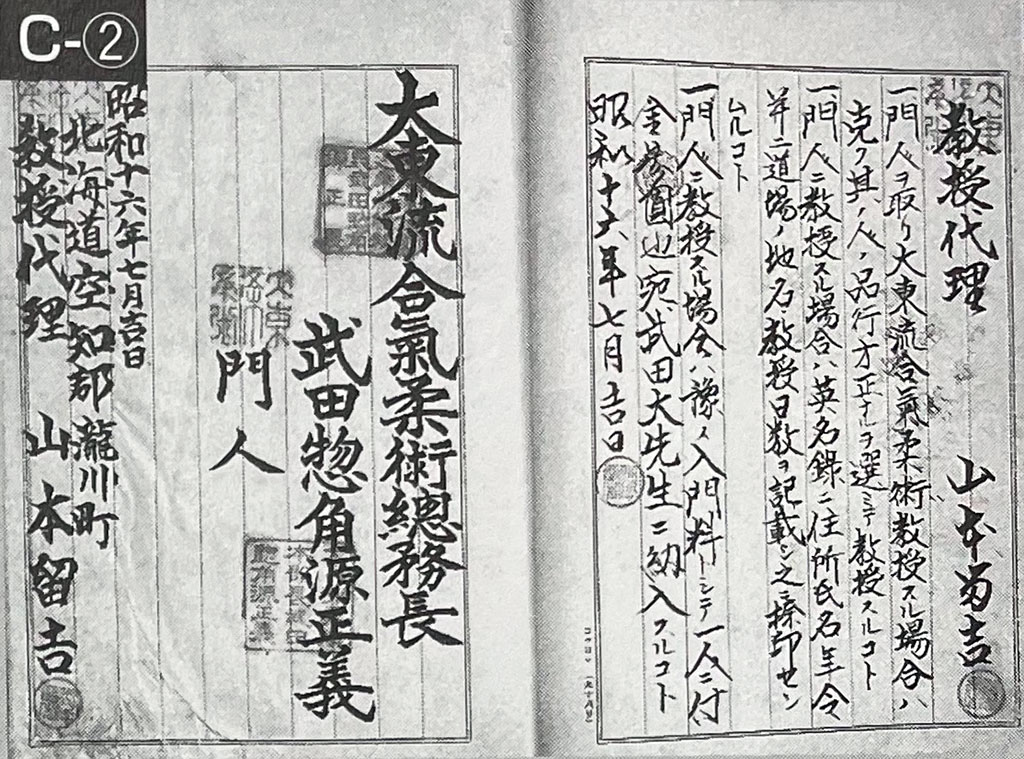 Beginning of Yamamoto's eimeiroku.
The above picture shows the first two pages of Yamamoto’s eimeiroku. The left one introduces Yamamoto as kyoju dairi and a student (門人 monjin) of "Takeda Sokaku Minamoto no Masayoshi" who is presented as the General manager of Daito-ryu Aikijujutsu (大東流合気柔術總務長, Daito-ryu Aikijujutsu Somucho). The page is officiated by Takeda by the presence of his square stamps of “Daito-ryu Jujutsu”, “Daito-ryu Hombu-cho Takeda Sokaku Minamoto no Masayoshi”, and “Aiki no Jutsu Somucho Takeda Sokaku Minamoto no Masayoshi”. The left page mentions the same conditions and financial requirements as are always written in Takeda’s eimeiroku.
The following commemorative photograph was taken during the awarding of hiden okugi no koto certificates to the Asahi Newspaper group. It is likely that all the individuals in this picture received it. On the other hand, Hisa Takuma and Yoshimura Yoshiteru are also holding their brand new eimeiroku booklets together with their certificates. Indeed, Hisa and Yoshimura were awarded the hiden okugi no koto certificates and became kyoju dairi simultaneously. On the other hand, others such as Nakatsu, Harada and Tonedate received the kyoju dairi later in 1937.
 Official picture taken at the Asahi newspaper in 1936 following the awarding of the hiden okugi no koto (1936). The photo is overexposed but an enhancement shows that the certificate held by Tonedate Masao is identical to Hisa's presented above in this article. It is also the same as the one Nakatsu Heizaburo received.
On the contrary, Yamamoto received his hiden okugi no koto certificate in 1942, one year after becoming kyoju dairi. The following picture shows Yamamoto holding his hiden okugi no koto certificate dated May, 1942. The picture is a little bit blurry but fortunately, we have another picture of the certificate. It is identical to the ones given to Horikawa in 1932 and Sagawa in 1938 and it is dated from May 1942.
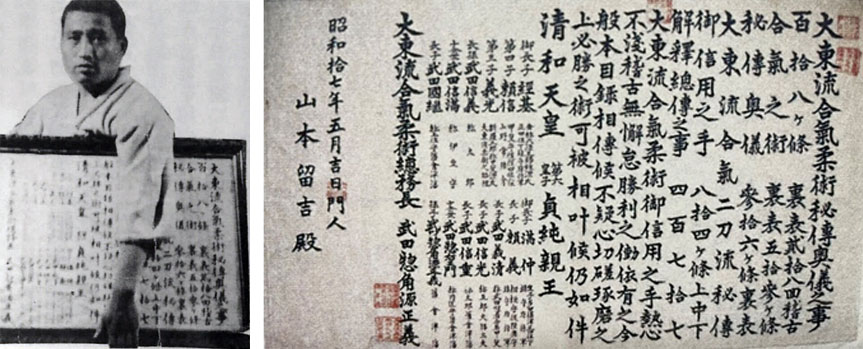 Yamamoto Katsuyoshi holding his hiden okugi no koto certificate.
Yamamoto attended Takeda as he passed away on April 25, 1943 in a ryokan in Aomori. Takeda’s full name was Takeda Sokaku Minamoto no Masayoshi. Takeda gave two characters from his name, 角 (kaku) and 義 (yoshi), and later in life, Yamamoto used the name Kakuyoshi as his martial name (武名). In addition, he is said to have received from Takeda the title of Daito-ryu aikijujutsu soshu (大東流合気柔術総主) or general chief of Daito-ryu.
 Yamamoto Kakuyoshi demonstrating a shumoku technique at his Jushinkan Dojo, in Hakodate.
Summary
Menkyo kaiden (license of full transmission) is usually given to a student when the teacher of a certain school has taught him all of the techniques in the curriculum. Unlike in koryu, Takeda’s curriculum seems to have developed throughout his teaching carrier. In a broader sense, someone who received all the instructions that were part of Takeda’s curriculum at a certain time could legitimately have been considered as menkyo kaiden of that era.

Ueshiba Morihei was the first in Daito-ryu history to have received the hiden okugi no koto certificate and consequently, he possessed the highest title in existence in Daito-ryu in 1922. Later, he developed his own art and became better known as the Founder of Aikido.
The certificate given to Horikawa Kodo was the highest level of transmission in Daito-ryu in 1931. He received instruction up to the kaishaku soden level which translates as “explanation of full transmission”. Since there wasn’t any higher certificate in existence at that time, Horikawa referred to it as menkyo kaiden during his life.
Hisa Takuma received his kaiden no koto certificate that contains 88 kaiden techniques, in addition to all pre-existing ones. Kaiden means “full transmission” and usually it is this certificate that is called menkyo kaiden in the Daito-ryu tradition.
Sagawa Yukiyoshi’s certificate mentions a special set of techniques called seito soden or “legitimate full transmission”. It’s not known whether anyone else than Sagawa received instruction in these techniques. In respect of the number of the techniques, Sagawa’s certificate list the most, however, he has never been referred to as menkyo kaiden.
Through this analysis, we hope to have demonstrated that the curriculum of Daito-ryu, and therefore its associated titles, was ever evolving throughout Takeda Sokaku's life. As such, a number of students could legitimately claim to have been exposed to the maximum amount of knowledge available at a particular time. Whether this implied an enhancement of fundamental skills, or a mere addition of technical variations remains to be clarified.
Special thanks to Guillaume Erard for his help with the documentation and editing of this article. Thank you to Josh Gold from Aikido Journal for letting us use their database. In addition, I would like to express my gratitude to Nomoto Tadashi sensei, for the useful discussion and the documents he provided for this research.
植芝 守央 (2022) - 合気道 その歴史と技法 ベースボール・マガジン社
今村 嘉雄 (1982) - 日本武道大系. 第6卷 同朋舎出版, 京都
Amdur, Ellis (2019) - Where’s My Money!!!???? - It Ain't Necessarily So
Dobroka, Mihaly (2024) - The Technical Evolution of Daito-ryu Aikijujutsu and the Development of Aikido - A Thorough Look Into the Secret Scrolls of Daito-ryu Part 6
Erard, Guillaume (2012) - Hisa Takuma, the Technical Successor of Takeda Sokaku
Erard, Guillaume (2016) - Biography of Nakatsu Heizaburo, the father of Shikoku's Daito-ryu aiki-jujutsu
Erard, Guillaume (2019) - Soden: The Secret Technical Manual of Daito-ryu Aiki-jujutsu
Erard, Guillaume (2020) - Ueshiba Morihei's "Escape from Osaka" - It Ain't Necessarily So
Stanley Pranin (1996) - Conversations with Daito Ryu Aikijujutsu Masters (p. 102)
